Many thanks to our friends Shana Rowan, executive Director at USA FAIR, Gail Colletta, President of the Florida Action Committee, and "Once Fallen" activist Derek Logue, for appearing live on HuffPost to denounce the posting of big red lawn signs in front of the homes of ex-sex offenders by the Sheriff of Bradford County, Florida.
Sunday, June 9, 2013


Tuesday, June 19, 2012
Making Injustice Visible
In the aftermath of the vigilante murders of two former sex offenders, I was encouraged by this report from KOMO news in Seattle, which is more balanced than we usually see in the media.
Police say Drum planned on coming to Quilcene next, where I reside, to kill another former offender. Was I that close to becoming another victim, not only of a killer but a system? I wondered the same thing back in 2005, when another vigilante was on the loose after he killed two other former offenders in Bellingham, less than a hundred miles from my location.
In KOMO’s coverage, and comments frequently made elsewhere, a hideous truth is revealed. Many citizens of this country feel the vigilante is a hero. It is a very short step from celebrating a murderer to becoming one. How did it happen that so many citizens - seemingly in their right minds otherwise – advocate cold-blooded killing?
One very large reason is that, by singling out people who have committed a sex offense, legalizing their discrimination, forcing their exclusion, and sanctifying the hatred against them, the United States government creates the optimal conditions for vigilantism to thrive. It goes even further by publishing a convenient hit-list online.
In U.S. criminal law, an “accessory to murder” is one who aids a perpetrator in committing that crime without directly participating. I would argue that providing the names, photos and detailed locations of former sex offenders does directly participate, which defines an accomplice. But either way, make no mistake: Every time a registered person is attacked or murdered for being on the registry, the government itself is culpable.
Lip Service
Police tell us they understand the "unintended" message the registry sends. They claim to take our vulnerability seriously, stating on registry websites and the notification posters they hang up that harassment of RSO’s is illegal and will not be tolerated. My own experience indicates the opposite. Were any of the people who harassed or threatened me over the years charged with anything? Not a one. I've heard the same from many other registered people.
During his murder spree, the Bellingham vigilante created a hit-list of Level 3's from the information he gathered on the online registry. As the only Level 3 in Jefferson County at that time, I had reason to worry that I was on his list. But did I get a warning from authorities that I could be targeted? Not a word. How about when I contacted them on my own, asking how they planned to ensure that I, a publicized target, would be protected until the killer was apprehended? “Try not to worry about it.”
Of course the source of the problem is not the police. They are just following the laws and sentiments enacted by a society determined to demonize one group of people, regardless of mitigating circumstances, documented facts, or basic human rights. And when you deny the rights and protections of one group of citizens, while at the same time claiming they have equal protection under the law, you create an impossible conundrum for enforcement authorities.
Granted, the vigilantes who succeed in eliminating their targets are usually apprehended and charged with murder, so it seems that registered persons do finally get some equal protection once they are dead. But the accessory to the murders – the U.S. laws that identify and enable the targeting of citizens who have already served their sentences – is never apprehended. And so the killings continue.
“Hate crimes send a message that certain groups of us are not welcome and unsafe in a particular community.”
From the Hate Crimes Prevention Act Website
Our society claims to regard hate crimes as more heinous than the same crimes committed without the motivation of prejudice. Clearly, vigilante murderers like Drum should be charged with hate crimes, just as all others who intentionally select their victims because of their race, religion, gender identity, disability, sexual orientation or cultural identity. But no hate-crime legislation exists for registered sex offenders – an exceptionally vulnerable “cultural identity” created and defined by U.S. laws – so their murderers are not held accountable under these laws.
House of Cards
We are told repeatedly, despite some uncomfortable legal difficulties regarding the U.S. Constitution, that the Sex Offender Registry is necessary for the protection of children. But this 2009 study shows that thirty-six percent of all reported sex offenses were committed by children, and that most will never commit another sex offense. The sex offender registry supposedly created to protect children is now stigmatizing them for life. And making them targets as well.
We are also told repeatedly that sex offenders are a greater threat than other criminals because they have high rates of re-offending. Twenty years of studies have proven this perception to be categorically false. In fact, sex offenders have one of the lowest rates of recidivism of any type of criminal.
Twenty years of studies have also revealed that the isolating, tough-on-crime approach of the registry not only fails to reduce sex crimes, but actually creates conditions more conducive to re-offense by driving offenders into hiding and preventing them from rejoining society once they have served their legal sentence.
Sex offender experts, law enforcement authorities, legal experts, human rights advocates and nearly everyone familiar with the problems the registry creates agrees that it causes far more damage than it prevents, that it is unjustifiable legally and unworkable in practice. So why is this house of cards still standing? Is it because the war on sex offenders is politically popular, like the failed War on Drugs or the ineffectual War on Cancer, even when there is no rational or ethical justification for it? Is it because targeting sex offenders makes good press?
The public registry has failed in its stated purpose. Far from protecting children or communities, its real effect is no less than criminal facilitation of murder and vigilantism. The time has come for the United States to abolish it.
Creating Ripples
There was far more to Jerry Ray and Gary Blanton than the crimes they committed and answered to. They were sons, brothers, fathers and husbands who were loved by their friends and families. Now all these people are grieving in the senselessness of these slaughters and why they happened. I sure hope nobody tries telling them the registry is not a punishment.
Our evolution as humans, and as a society, has only ever occurred when we decided to extend compassion and human rights to those who had lost them, or did not have them in the first place. If we want to continue to evolve, wouldn’t forgiveness and restoration be better choices than the deliberate creation of an underclass, reinforced by legal authorities and subjected to the violence and harassment of the majority?
But how does a system so entrenched get changed? How can the public, media, and politicians be convinced that the registry has failed and it’s time to end it? Margaret Mead said it simply: “Never doubt that a small group of thoughtful, committed citizens can change the world. Indeed, it is the only thing that ever has.”
Steve at RSOonline wrote, “Let’s not forget that we are all connected. We’re either on the sex offender registry or friends and family of someone that is."
Indeed we are connected. With nearly 800,000 persons registered today, and our friends and family numbering in the millions, we have a very powerful voice. We can talk to people about the registry. We can blog, write, and tweet about it. We can e-mail our representatives and write comments in the media.
Together, we can do what Gandhi prescribed, which eventually liberated a nation. We can “Make Injustice Visible.”
In the spirit of compassion and connection, Shana at I love a Sex Offender initiated this fund drive to aid the widow of Gary Blanton. Please show her that she is not alone.
Police say Drum planned on coming to Quilcene next, where I reside, to kill another former offender. Was I that close to becoming another victim, not only of a killer but a system? I wondered the same thing back in 2005, when another vigilante was on the loose after he killed two other former offenders in Bellingham, less than a hundred miles from my location.
In KOMO’s coverage, and comments frequently made elsewhere, a hideous truth is revealed. Many citizens of this country feel the vigilante is a hero. It is a very short step from celebrating a murderer to becoming one. How did it happen that so many citizens - seemingly in their right minds otherwise – advocate cold-blooded killing?
One very large reason is that, by singling out people who have committed a sex offense, legalizing their discrimination, forcing their exclusion, and sanctifying the hatred against them, the United States government creates the optimal conditions for vigilantism to thrive. It goes even further by publishing a convenient hit-list online.
In U.S. criminal law, an “accessory to murder” is one who aids a perpetrator in committing that crime without directly participating. I would argue that providing the names, photos and detailed locations of former sex offenders does directly participate, which defines an accomplice. But either way, make no mistake: Every time a registered person is attacked or murdered for being on the registry, the government itself is culpable.
Lip Service
Police tell us they understand the "unintended" message the registry sends. They claim to take our vulnerability seriously, stating on registry websites and the notification posters they hang up that harassment of RSO’s is illegal and will not be tolerated. My own experience indicates the opposite. Were any of the people who harassed or threatened me over the years charged with anything? Not a one. I've heard the same from many other registered people.
During his murder spree, the Bellingham vigilante created a hit-list of Level 3's from the information he gathered on the online registry. As the only Level 3 in Jefferson County at that time, I had reason to worry that I was on his list. But did I get a warning from authorities that I could be targeted? Not a word. How about when I contacted them on my own, asking how they planned to ensure that I, a publicized target, would be protected until the killer was apprehended? “Try not to worry about it.”
Of course the source of the problem is not the police. They are just following the laws and sentiments enacted by a society determined to demonize one group of people, regardless of mitigating circumstances, documented facts, or basic human rights. And when you deny the rights and protections of one group of citizens, while at the same time claiming they have equal protection under the law, you create an impossible conundrum for enforcement authorities.
Granted, the vigilantes who succeed in eliminating their targets are usually apprehended and charged with murder, so it seems that registered persons do finally get some equal protection once they are dead. But the accessory to the murders – the U.S. laws that identify and enable the targeting of citizens who have already served their sentences – is never apprehended. And so the killings continue.
“Hate crimes send a message that certain groups of us are not welcome and unsafe in a particular community.”
From the Hate Crimes Prevention Act Website
Our society claims to regard hate crimes as more heinous than the same crimes committed without the motivation of prejudice. Clearly, vigilante murderers like Drum should be charged with hate crimes, just as all others who intentionally select their victims because of their race, religion, gender identity, disability, sexual orientation or cultural identity. But no hate-crime legislation exists for registered sex offenders – an exceptionally vulnerable “cultural identity” created and defined by U.S. laws – so their murderers are not held accountable under these laws.
House of Cards
We are told repeatedly, despite some uncomfortable legal difficulties regarding the U.S. Constitution, that the Sex Offender Registry is necessary for the protection of children. But this 2009 study shows that thirty-six percent of all reported sex offenses were committed by children, and that most will never commit another sex offense. The sex offender registry supposedly created to protect children is now stigmatizing them for life. And making them targets as well.
We are also told repeatedly that sex offenders are a greater threat than other criminals because they have high rates of re-offending. Twenty years of studies have proven this perception to be categorically false. In fact, sex offenders have one of the lowest rates of recidivism of any type of criminal.
Twenty years of studies have also revealed that the isolating, tough-on-crime approach of the registry not only fails to reduce sex crimes, but actually creates conditions more conducive to re-offense by driving offenders into hiding and preventing them from rejoining society once they have served their legal sentence.
Sex offender experts, law enforcement authorities, legal experts, human rights advocates and nearly everyone familiar with the problems the registry creates agrees that it causes far more damage than it prevents, that it is unjustifiable legally and unworkable in practice. So why is this house of cards still standing? Is it because the war on sex offenders is politically popular, like the failed War on Drugs or the ineffectual War on Cancer, even when there is no rational or ethical justification for it? Is it because targeting sex offenders makes good press?
The public registry has failed in its stated purpose. Far from protecting children or communities, its real effect is no less than criminal facilitation of murder and vigilantism. The time has come for the United States to abolish it.
Creating Ripples
There was far more to Jerry Ray and Gary Blanton than the crimes they committed and answered to. They were sons, brothers, fathers and husbands who were loved by their friends and families. Now all these people are grieving in the senselessness of these slaughters and why they happened. I sure hope nobody tries telling them the registry is not a punishment.
Our evolution as humans, and as a society, has only ever occurred when we decided to extend compassion and human rights to those who had lost them, or did not have them in the first place. If we want to continue to evolve, wouldn’t forgiveness and restoration be better choices than the deliberate creation of an underclass, reinforced by legal authorities and subjected to the violence and harassment of the majority?
But how does a system so entrenched get changed? How can the public, media, and politicians be convinced that the registry has failed and it’s time to end it? Margaret Mead said it simply: “Never doubt that a small group of thoughtful, committed citizens can change the world. Indeed, it is the only thing that ever has.”
Steve at RSOonline wrote, “Let’s not forget that we are all connected. We’re either on the sex offender registry or friends and family of someone that is."
Indeed we are connected. With nearly 800,000 persons registered today, and our friends and family numbering in the millions, we have a very powerful voice. We can talk to people about the registry. We can blog, write, and tweet about it. We can e-mail our representatives and write comments in the media.
Together, we can do what Gandhi prescribed, which eventually liberated a nation. We can “Make Injustice Visible.”
In the spirit of compassion and connection, Shana at I love a Sex Offender initiated this fund drive to aid the widow of Gary Blanton. Please show her that she is not alone.
Tuesday, August 30, 2011
KIRO RADIO INTERVIEW: Level 3 Speaks Up
Today, out of the blue, I got a message from KIRO Radio in Seattle wanting to interview me about the sex offender registry. I went on shortly thereafter, the hosts John Curley and Rachel Belle were great, and I was able to get across a few good points. What I failed to relate, however, was what I did to get the label. Explaining how my drunken advances resulted in a lifetime registration would have taken a much longer show. Instead I referred listeners to the Stranger article on my blog sidebar for a critical interpretation. For the record: I did not molest a child, kidnap or rape anyone, as people often assume given my Level 3 classification.
Here's the Radio Show post and Audio Link on MY NORTHWEST.COM
Many thanks to KIRO Radio and the whole newsroom crew!
Here's the Radio Show post and Audio Link on MY NORTHWEST.COM
Many thanks to KIRO Radio and the whole newsroom crew!
Wednesday, August 24, 2011
Ex-Offender Mentorship: Level 3's Working Together

The seed was planted back in 2007, when my former probation officer asked if I could help a Level 3 Sex Offender under his watch. Was he kidding? The fact that he would look to me—after all the trouble I experienced under my own Level 3 designation—felt ironic beyond words.
Then again, it was also quite a testament to the successes I’d achieved since completing probation. And from that perspective, his request made perfect sense. Who better to help someone saddled with a monster’s label than one who had managed to rise above it? Unfortunately, I had so much on my plate at that time that I never followed up on this fascinating opportunity. But it was an idea I never forgot.

So when one of my employees told me about Christopher Gaylord—a likable young man trying to find work under a Level 3 label—I knew immediately that I wanted to meet him.
Chris smiled as I pulled up in my truck, looked directly in my eyes as we were introduced, and reached out to shake my hand. “Thank you for giving me this chance.”

He told me about being molested repeatedly when he was eleven, how he acted-out as a result, and how this led to him being convicted of two juvenile sex offenses by the time he was fifteen. He also described the ten years he spent growing up in various programs and institutions, including three years fighting a civil commitment sentence from McNeil Island, the Alcatraz of the Pacific Northwest.


At my property I showed Chris the river running through the forest, the house I built with the help of my community, and various areas of the Zen Garden still in development. “This is exactly what I’d like to build for myself someday,” he said. It was a good sign that he used the term build instead of get, as I emphasized that achieving great things with a monster’s label is not for the faint of heart.


I wondered whether Chris’s remarkable attitude—or any of his admirable qualities—was considered when the Sheriff’s Department did his risk assessment. If my own Sheriff’s assessment is any indication, the answer is no. And I find this very sad.

Some people might wonder: “Won't it look bad on you if he offends again?” To them I would say that nobody is without risk, and I would rather have helped out of compassion than to have turned away out of fear. It’s incomprehensible to me that our courts are regularly trying children as adults, and branding adults for offenses they committed as children. The sex offender registry was supposedly established to protect children but now, tragically, so many children are its victims.

Note: As this story went to post I learned that Chris was told by a Parks official that he cannot continue living in any Jefferson County campgrounds.
I look forward to the day when the mindset that developed these wonderful programs described in Yes Magazine is applied to ex-sex offenders...for the benefit of everyone.
Tuesday, March 22, 2011
Sex Offender Speaker: California Outreach

A few months back I was contacted by a woman writing about sex offenders for her new book. She said she was impressed by the quality and candidness of the blogs she’d read on MonsterMart, and wondered if I would answer some questions. Gladly!
 Turns out I was speaking with Dr. Nandi Crosby, author, feminist, former corrections officer, and Professor of Sociology and Women’s Studies at California State University, Chico. Here’s a fascinating article about her life and work. And a link to Dr. Nandi's first book, If My Soul Be Lost.
 When Dr. Nandi asked me to be a guest speaker in her classes I was honored and excited to accept. For several years I’ve wanted to begin speaking publicly about my crimes and the label I was given as a result. Dr. Nandi’s invitation was a great opportunity to educate students about the severe consequences sex offenders experience today through sharing my own story, especially how being on the registry has affected my life.
 Was I nervous? No doubt. Speaking about any subject for hours would be challenging enough, let alone one as sensitive as sexual offense. Add in the shame that still arises from my childhood incest, as well as the behavior that put me on the registry as an adult, and the prospect of "baring it all" seemed all the more daunting.
At the same time I’ve come to understand how powerfully healing walking through this kind of vulnerability can be, for victim or offender alike. And having been on both ends of the spectrum means I can speak from experience.
 Since all that most people ever know about a sex offender is a description of his crimes and a mugshot, I passed out copies of my own public notification poster early on. This led to discussion of how badly communities can react to an offender's presence, what limited information the notice contains, and the confusion that can result from the use of terms that seem violent or threatening to children even when the crimes were not.
 The context of each class was slightly different, but in all of them I detailed my crimes, jail sentences, court-ordered treatment, and some of the many problems that came with being classified at the highest level of the registry for life. I also talked about the broader implications of the registry in our society, dispelled some of the pervading myths about sex offenders, and tried to illustrate how emotionally-driven sex offender laws can (and often do) cause more harm than good.
 Not all the students were sympathetic. Some directly challenged my opinions, and some asked questions that could not be answered simply. But overall the students seemed eager to learn, their questions were insightful and intelligent, and there were even a few laughs.
 Dr. Nandi offered helpful feedback along the way, the most meaningful being that my presentations were so authentic. Equally moving to me were the many handshakes I got from students afterwards, thanks for appearing, and congratulations on my work.
 Ultimately, whether students agreed with my perspectives or not, I hope they left with a better understanding of the issues involved, and a greater willingness to think and talk openly about matters that are usually avoided. After this valuable first experience at Chico State I'll be looking for my next opportunity to speak and teach, wherever that may be. University of Paris anyone?
Wednesday, February 16, 2011
Living Beyond the Label Part II: A Level 3’s Housewarming

Never have I felt a greater kinship with the online community of ex-sex offenders than when I wrote about my dream of building my own home (see part one below). The heartfelt messages I received showed me just how important personal dreams and accomplishments are for so many on the registry. For all those who wrote, and anyone struggling to live beyond the label, I wanted to post this special update.

Last September I had the pleasure of welcoming a crowd of guests from near and far—family, friends, craftsmen and many of my neighbors. A housewarming was a great way to bring together the many people involved in my life and creative ambitions over the last 3 years, to show my appreciation with a delicious outdoor feast, and to proudly present the final results.

All the compliments and loving hugs I got that day felt amazing. And the talk about submissions to architectural magazines was especially meaningful to me since I had designed every element myself. But as I told my guests, it was the help I got from local craftsmen that turned my visions into reality. This got me thinking again about how much my relationship with the community had changed since I arrived.
 While creative expression has always come naturally to me, expressing my higher self in this community with a sex offender label was not so easy. Every time people reacted badly to my label--and there were plenty of disturbing incidents--it was a challenge not to feel depressed, angry or afraid. For quite some time I felt like getting as far away from this place as possible!
  But once I decided to stay I saw that, for better or worse, this was the only local community I had. Was I going to isolate myself because of my label, avoid interactions, and live in a perpetual state of anxiety and fear? I never wanted a hermit’s life. And I sure didn’t want to give my label any more power than it deserved. I wanted to be a good neighbor and friend to the people around me. I wanted to be involved. And the fact was I needed help bringing my plans to fruition.
Eventually I understood that people weren’t reacting to me as I am, or as I could be, but to projections of their own fears. And if I reacted to them in the same ways—with fear, anger and condemnation—then nothing was going to change. How would they know there was more to me than a label if I wasn't willing to show them? Regardless of how I had been treated, or what I imagined people thought of me, I could choose to approach anyone I met with respect, openness and trust. I could be the change I wanted to see.
 When Stan and Linda first heard about my label they feared it could cause problems with their rental property next door. But they’ve since told me the passion and dedication I revealed was more important than their doubts. Stan spent countless hours working on my property with his tractor and his engineering expertise. And Linda visited often with encouragement and praise for the progress she saw. Today they treat me with the warmth of an adopted son, and I am invited to all their family gatherings.
 Ray had seen my sex offender poster on a visit to the sheriff’s office, and spread this information around town to people who didn’t yet know. But Ray also owned a lumber mill, and was one of Stan’s friends. So I put my fears aside and approached him about materials for my house. It was he who supplied all the old-growth cedar siding that was ideal for my cabin exterior, at a price that would have been double anywhere else.
 Deborah was the detective who interrogated me when I first came to the area and was charged with failure to register. Since then she has retired from the Sheriff’s Department and opened a business as a professional seamstress. Today we have a friendship that would have seemed impossible before, and it was Deborah who made the curtains for my closets and the cushion for my living room couch.

Adam is the sheriff’s deputy assigned to make official checks on me. I used to feel resentful when he showed up unannounced. But showing him a grumpy face not only felt unnatural, it seemed unfair to the man forced to carry out this uncomfortable duty. So I began to invite Adam inside, show him my progress, and talk about whatever might come up. When I asked him if attending my housewarming presented a conflict of interest for him considering our “official” roles, he said: “We’re also neighbors.”
 Do I still get rejected for my label? Yes. I’ve met people that had great potential as friends, only to watch them vanish from my life when they discovered my label. But by choosing to act out of compassion rather than fear, I just let them go without resentment and move on.
 Four hundred years ago, poet John Donne wrote, "No man is an island, entire of itself...." Today his words are as meaningful as ever. I need my friends and supporters of the online community who are striving to fulfill their own dreams against the odds. And I also need my local friends and neighbors that bring richness and joy to my daily life.
Sunday, September 26, 2010
FINAL LOSS OF A DISTANT FATHER
 Late last year I received news that was the tragic final chapter of a long and heartbreaking story: my father had committed suicide.
I have never loved any man as deeply as my own father. He was the hero of my early childhood, my sensitive and patient confidant, my protector and awe-inspiring mentor.
It was through extraordinary experiences with him that I developed a wondrous curiosity about the world, a sacred bond with nature, a great respect for art and science, and even a humorous appreciation for the many ironies and absurdities of human nature which, I later learned, were closer than I imagined. But perhaps more valuable than any of these, my father taught me that with persistence and faith nothing was impossible.
Larger than life in so many ways, my father attained a kind of mythic status in the filmmaking community for his bold approach and innovations. The fact that he risked his life so many times pursuing the “impossible shot”—be it hanging from a helicopter or a crane over the ocean, galloping on horseback, or running up a towering Mayan Temple, all fully-loaded with eighty pounds of camera gear—made it all the harder to imagine that anything could bring down the Mountain Man of Steadicam.
But as bright as my father burned, he was also haunted by powerful shadows. One of them surrounded me, his eldest son, and the sad estrangement we had suffered since my childhood. For despite all the gifts he brought to my early life, my father also gave me a burden I am still recovering from today. That burden was incest.
Although childhood sexual abuse can damage on many levels, my own trauma came less from the physical acts than the secrecy that surrounded them. What might have been addressed openly in a relatively short period festered for years in secret, destroying the close relationship my father and I had known, and spreading to every corner of my life. While people often told me how much they admired my father and how proud of him I should be, I shrank in the shameful reality only he and I knew. As I shrank, not only did I lose my father, but I lost a large part of myself. And my descent into dishonesty, substance abuse and crime is typical of the self-destruction so many children adopt when issues this powerful go unaddressed.
Did I come to hate my father? If the bottom of hate is frustrated love, then the answer is yes. It was incomprehensible to me that a man who could do anything he set his mind to would fail to repair our broken relationship. But I was a child, and the mistake I often made was to perceive his unwillingness to face my pain as a rejection of me personally. I didn’t understand then that my father was afraid—of me, of himself, of facing a shame that started in his own family, as he reluctantly admitted to me once, and may have been repeated over many generations.
When my self-destructive course led to sexual transgressions of my own, it seemed all the more urgent for my father to open up and talk with me. I didn't blame him for the bad choices I made as an adult. And he did try to help me in his own way, sometimes with money or a visit to me in jail. But what I really needed was for us to work on healing together. Sadly, I used his avoidance of this as another excuse to continue harming myself.
The irony that my father had escaped the sex offender label for behaviors society considers far more serious than mine was something I wondered about many times. But I never wanted to hurt my father. And I never wished him to receive the label or the severe societal punishment that comes with it. I have come to understand that our self-punishment is often harsher than any other.
A significant part of my own recovery was learning to let go of the resentment I carried for my father for so many years, including facing the idea that he might never be capable of a close relationship with me again. As sad as this was to accept, I believe this freed me to mature in ways I had been stuck, address my own issues, regardless of where they originated, and create a life worth living. But I never gave up hope that one day we would be close again.
These last few years I felt healthy enough to try redefining our relationship, if only my father believed that possible. I dreamed of him coming to see the beautiful life and home my recovery made possible, where he could see me, maybe for the first time since my early childhood, driven by inspiration and dreams rather than shame. I wanted to show him that I was no longer defined by our broken past. But more than anything else, I hoped to inspire him to make some of the same choices—not for me any longer, but for himself.
I believe there were many causes to my father’s depression that had nothing to do with me. Evidence suggests he was alcoholic, and the breakdown of two marriages was particularly painful for him. Of course, I have no way of being certain what was in my father’s heart and mind over the years. But I believe he regarded any attempt to address what he saw as his “failures” as hopeless, and it seemed he treated other shadows the same way he treated our estrangement—by hoping they would just quietly go away.
We are all individuals, and what works for one person doesn’t necessarily work for another. But in the realm of deep human pain and suffering I have learned that we are far more alike than we are different. Change happens not by wishing things were different, but by developing the willingness to do whatever it takes to change. And that means at least trying the avenues that have worked for others.
One of the reasons it took me so long to embrace my own recovery was the idea that I was different from others, what one recovery program calls being “terminally unique.” My father and I were alike in this belief that what others did could never work for us. But when I finally got past this isolating, ego-based position, I found forgiveness for my father, myself, and many others that had felt impossible before.
My father may have believed that putting all his creative effort into a larger-than-life persona could somehow transform his shadows. But focusing on an external image at the expense of an internal reality not only gives the shadows more power, but can tragically make our most positive accomplishments feel false and empty. There is no longer any doubt that my father felt deep remorse and pain. And when that kind of pain is stuffed, held secret, or denied it becomes heavier than the whole world. I believe this terrible weight, and his inability to address it, is what ultimately killed my father.
Healing the wounds of our past and pain of the present is difficult work. But through my own recovery I have learned that it isn’t nearly as horrifying as we think it will be. And when you finally surrender to the truth with yourself and others, not only can you find a genuine interest in understanding your own issues and how to address them, which is so crucial to recovery, but magical things begin to happen. True healing happens.
 For me, the lessons of my father’s life and death are powerful beyond the ability of words to tell. There is no redemption in the world “out there.” Not for him, not for any of us. Redemption happens when we are willing to go deep inside, facing the worst that we have been and the worst that has been done to us. It is through this courageous and humbling work that we see our darkest experiences transformed into strengths to be shared, even celebrated, rather than weaknesses to be hidden. In the process we learn that we are worth it.
I never stopped loving you, Dad. And I will miss you for the rest of my life.
Sunday, June 14, 2009
Living Beyond The Label: Level 3 Dreams Come True
A daunting list of goals left no time for activism these last few months, but what a time it’s been! Dreams I once thought lost for me are now amazing realities—and one profound truth stands out: society’s darkest label cannot define us, no matter what we’ve done, or what the “official” record says, unless we give up; unless we fail to pursue our greater selves and visions.
 Six years ago my life was a 24-hour nightmare. Forced to stay in a community that had branded me a horrific threat to society, I had been cursed, evicted, fired and attacked. No matter what I did, all the doors closed--no friends anywhere, no work, no shelter, and no effective way to escape the fear and hate at every turn but an alcoholic oblivion. This would have been a solution if it killed me. But it only made the questions harder to fathom: How could I survive with a monster’s identity? Where could I go? What could I do?
 Then I saw a place that shifted my perspective—a trashed-out clearing in the forest with an old rotting trailer. At that point any structure looked better than a roadside ditch. But what gave me a sense of peace and security were the monolithic Cedar trees that had somehow escaped the chainsaws—eight-feet wide at the base and older than Abraham Lincoln! The dark slope below these giants was thriving with nature’s shady survivors—sword, wood, and maidenhair ferns, foxglove, huckleberry, blooming white trillium and, twisting across the canopy like sculptures, mossy vine maples searching for the light. Then I heard what had been whispering all along; at the bottom of the slope was a sparkling mountain river!
With a peculiar sense of faith I knocked on the property owner’s door and told him my story. I don’t know why he chose to overlook my frightening label, but when he agreed to rent me the trailer for next to nothing, I took it as a blessing—and an answer. So while the Sheriff’s Department got busy hanging my photo on the streets and contacting my new neighbors with door-to-door warnings, I got busy on a vision.
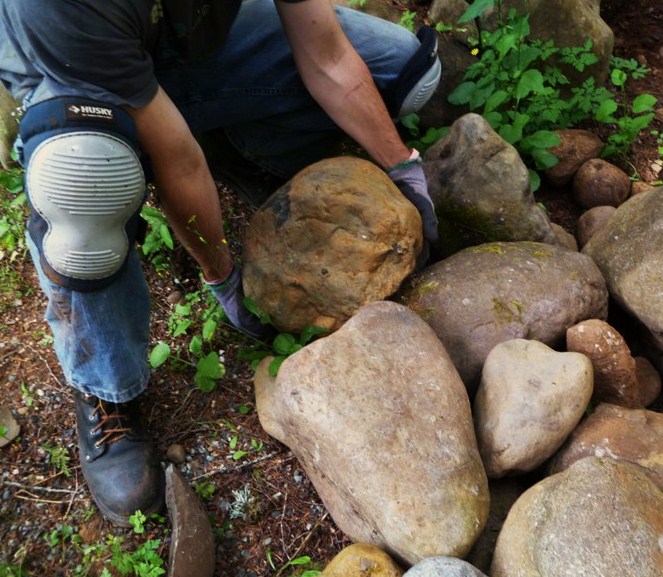
It’s funny how a meaningful purpose can make the hardest, dirtiest, unpaid work feel like a spiritual practice. Turning old neglect into new respect not only got me back in touch with my creative self-worth, I found myself thinking less and less about public opinions and labels. This was so relieving I just didn’t want to quit! So when the trailer was pristine, I started on the clearing, and when that was like an empty canvass, I began building a garden worthy of a sacred retreat. Maybe I seemed obsessed rolling boulders in the moonlight, but the art of re-creation engaged me completely. This is how part of the Zen Garden turned out.
It was interesting how my landlord started improving his own yard during this time. And when he got a closer look at my progress, he reduced my rent even further! I wondered: was it me doing the restoring, or me being restored? One thing was clear; the magic of these relationships depended on my sobriety. So despite the fear I felt in public, I started going to local meetings, got myself a sponsor, and worked the steps.
It's encouraging that positive news can still travel as fast as the negative. Soon I found myself restoring the garden of a prominent community member. And soon after that I had so much work I needed to hire help. That’s how my landscaping business was born and developed. And that’s how I became financially solvent.
I feared the nightmare was returning when my landlord lost his job and had to sell the property. Moving not only meant losing the place I valued so much, on so many levels, but having my monster label broadcast all over again at the next address—if I could even find one. But this time I stayed sober, and used the tools of the program. And right about the time I decided to create another garden wherever I landed, my landlord proposed a deal instead.
 It still seems beyond reason that he would offer to sell me the property for many thousands less than what he paid. But when the deal was signed on March 10th, 2005, he thanked me for helping him; by covering his late payments I had saved him from the stigma of foreclosure!
I was speechless, to say the least. But when the reality of this dream finally sunk in, I realized the way had been cleared for another—so I kept going. Here I am collecting materials for a riverside cabin!
Right from the start county officials told me that a new structure on my property would not be permitted—for a number of reasons. But I didn’t accept No as an answer; not to make problems, but to find creative solutions. And the fact is I heard many more No’s before I heard the first Yes.
 Now the requirements have all been met, and my dream cabin is standing tall and strong. By summer’s end I hope to have the interior finished in natural woods, stones and shade-loving plants—a tribute to the paradise right outside.
Many things in my life remain uncertain. But I do know that none of this would have happened without faith, sobriety and commitment as my companions, or the priceless support of people who see much deeper than labels.
.JPG) Now I'm certain that if we can manage to believe in ourselves, our visions and our dreams enough to follow them wherever they lead, the Universe is always saying YES.
Now I'm certain that if we can manage to believe in ourselves, our visions and our dreams enough to follow them wherever they lead, the Universe is always saying YES.
 Six years ago my life was a 24-hour nightmare. Forced to stay in a community that had branded me a horrific threat to society, I had been cursed, evicted, fired and attacked. No matter what I did, all the doors closed--no friends anywhere, no work, no shelter, and no effective way to escape the fear and hate at every turn but an alcoholic oblivion. This would have been a solution if it killed me. But it only made the questions harder to fathom: How could I survive with a monster’s identity? Where could I go? What could I do?
 Then I saw a place that shifted my perspective—a trashed-out clearing in the forest with an old rotting trailer. At that point any structure looked better than a roadside ditch. But what gave me a sense of peace and security were the monolithic Cedar trees that had somehow escaped the chainsaws—eight-feet wide at the base and older than Abraham Lincoln! The dark slope below these giants was thriving with nature’s shady survivors—sword, wood, and maidenhair ferns, foxglove, huckleberry, blooming white trillium and, twisting across the canopy like sculptures, mossy vine maples searching for the light. Then I heard what had been whispering all along; at the bottom of the slope was a sparkling mountain river!
 With a peculiar sense of faith I knocked on the property owner’s door and told him my story. I don’t know why he chose to overlook my frightening label, but when he agreed to rent me the trailer for next to nothing, I took it as a blessing—and an answer. So while the Sheriff’s Department got busy hanging my photo on the streets and contacting my new neighbors with door-to-door warnings, I got busy on a vision.

It’s funny how a meaningful purpose can make the hardest, dirtiest, unpaid work feel like a spiritual practice. Turning old neglect into new respect not only got me back in touch with my creative self-worth, I found myself thinking less and less about public opinions and labels. This was so relieving I just didn’t want to quit! So when the trailer was pristine, I started on the clearing, and when that was like an empty canvass, I began building a garden worthy of a sacred retreat. Maybe I seemed obsessed rolling boulders in the moonlight, but the art of re-creation engaged me completely. This is how part of the Zen Garden turned out.
It was interesting how my landlord started improving his own yard during this time. And when he got a closer look at my progress, he reduced my rent even further! I wondered: was it me doing the restoring, or me being restored? One thing was clear; the magic of these relationships depended on my sobriety. So despite the fear I felt in public, I started going to local meetings, got myself a sponsor, and worked the steps.
It's encouraging that positive news can still travel as fast as the negative. Soon I found myself restoring the garden of a prominent community member. And soon after that I had so much work I needed to hire help. That’s how my landscaping business was born and developed. And that’s how I became financially solvent.
I feared the nightmare was returning when my landlord lost his job and had to sell the property. Moving not only meant losing the place I valued so much, on so many levels, but having my monster label broadcast all over again at the next address—if I could even find one. But this time I stayed sober, and used the tools of the program. And right about the time I decided to create another garden wherever I landed, my landlord proposed a deal instead.
 It still seems beyond reason that he would offer to sell me the property for many thousands less than what he paid. But when the deal was signed on March 10th, 2005, he thanked me for helping him; by covering his late payments I had saved him from the stigma of foreclosure!
 I was speechless, to say the least. But when the reality of this dream finally sunk in, I realized the way had been cleared for another—so I kept going. Here I am collecting materials for a riverside cabin!
Right from the start county officials told me that a new structure on my property would not be permitted—for a number of reasons. But I didn’t accept No as an answer; not to make problems, but to find creative solutions. And the fact is I heard many more No’s before I heard the first Yes.
 Now the requirements have all been met, and my dream cabin is standing tall and strong. By summer’s end I hope to have the interior finished in natural woods, stones and shade-loving plants—a tribute to the paradise right outside.
Many things in my life remain uncertain. But I do know that none of this would have happened without faith, sobriety and commitment as my companions, or the priceless support of people who see much deeper than labels.
.JPG) Now I'm certain that if we can manage to believe in ourselves, our visions and our dreams enough to follow them wherever they lead, the Universe is always saying YES.
Now I'm certain that if we can manage to believe in ourselves, our visions and our dreams enough to follow them wherever they lead, the Universe is always saying YES.
Sunday, March 1, 2009
Questioning Punishment : Guest Blog by E.L. Taylor
The use of punishment is so entrenched in our judicial system that most of us never question it. When you commit a crime and are caught, you will be punished for it. Just as when a child commits an offense and is caught, he is punished for it – often without understanding what he has done “wrong.” But understanding is not the goal of punishment. Its intent is to instill the fear of punishment, in hopes that fear will prevent further misdeeds, thus (theoretically) making the perpetrator a better person and making the family or society safer.
It might be a reasonable system, both in families and in societies, if it worked. But countless studies of both children and criminals indicate that it does not work. The punishment of children ultimately does not make them better people. It makes them fearful and angry people. And criminals who are punished are more likely to re-offend, not less.
James O’Dea has witnessed the results of the system of punishment in many places in the world. As former director of Amnesty International, he has spent a lot of time in war zones and torture prisons. In a recent speech (read the full transcript here), Mr. O’Dea said:
To me, having seen so much of human suffering and war and torture in my own life I know that this [punishment system] is one of the most profound mimetic structures human beings need to overcome. If we look at the dysfunctional nature of the punishment system in the United States, and we say to ourselves, “The United States, which has evolved in many ways, its democracy, is less than 5% of the world’s population but it contains one-third of world’s prisoners.” We can hold up a mirror to ourselves and say, “Why is this so?” Why would one third of the entire global prison population be housed in one of the world’s leading democracies? It relates to this concept of punishment, that somehow punishing others will relieve us and correct our situation.
Mr. O’Dea asks, How do we move into a consciousness … that attends to what is important, that moves away from stereotyping and “otherizing” but that finally moves away from the need to punish others?
Not all justice systems (nor all families) are based in punishment. Some Native American tribal traditions, as well as those of other groups, are based on the idea that if one person in a family or a community errs, it is the responsibility of the entire family or community for failing that person in some way. Restorative justice seeks to redress wrongs through reconciliation, restoration, healing and rehabilitation. Read more about Restorative Justice here.
Maybe the time has come for us to begin to question the practice of punishment – whether incarceration or registration - as a judicial tool, and to look for other answers for creating a better world.
E. L. Taylor
I've wondered what might have happened if I had been able to sit down with a restorative mediator and the two women I offended. We would have had an opportunity to speak to one another directly and courageously, look at what happened as well as what didn’t happen, take responsibility, vent feelings, offer explanations, and show remorse to those who need to see it most. These are elements of healthy resolution - and even the possibility of forgiveness - that the judicial system denies in its punishment-based approach.
Seventeen years after my first offense, encouraged by my recovery program, I tried to make amends to the “victim” through a third party. Her refusal, as it was relayed to me, indicated that her anger is as fresh today as it was the night I tried – inappropriately and drunkenly – to seduce her.
I don’t believe the judicial system’s prescription – vengeance and ongoing punishment – has served either one of us well. There has been no resolution: She is still angry and traumatized, and I am still being punished…for the rest of my life.
An eye for an eye only ends up making the whole world blind. Mahatma Gandhi
Erik Mart
It might be a reasonable system, both in families and in societies, if it worked. But countless studies of both children and criminals indicate that it does not work. The punishment of children ultimately does not make them better people. It makes them fearful and angry people. And criminals who are punished are more likely to re-offend, not less.
James O’Dea has witnessed the results of the system of punishment in many places in the world. As former director of Amnesty International, he has spent a lot of time in war zones and torture prisons. In a recent speech (read the full transcript here), Mr. O’Dea said:
To me, having seen so much of human suffering and war and torture in my own life I know that this [punishment system] is one of the most profound mimetic structures human beings need to overcome. If we look at the dysfunctional nature of the punishment system in the United States, and we say to ourselves, “The United States, which has evolved in many ways, its democracy, is less than 5% of the world’s population but it contains one-third of world’s prisoners.” We can hold up a mirror to ourselves and say, “Why is this so?” Why would one third of the entire global prison population be housed in one of the world’s leading democracies? It relates to this concept of punishment, that somehow punishing others will relieve us and correct our situation.
Mr. O’Dea asks, How do we move into a consciousness … that attends to what is important, that moves away from stereotyping and “otherizing” but that finally moves away from the need to punish others?
Not all justice systems (nor all families) are based in punishment. Some Native American tribal traditions, as well as those of other groups, are based on the idea that if one person in a family or a community errs, it is the responsibility of the entire family or community for failing that person in some way. Restorative justice seeks to redress wrongs through reconciliation, restoration, healing and rehabilitation. Read more about Restorative Justice here.
Maybe the time has come for us to begin to question the practice of punishment – whether incarceration or registration - as a judicial tool, and to look for other answers for creating a better world.
E. L. Taylor
I've wondered what might have happened if I had been able to sit down with a restorative mediator and the two women I offended. We would have had an opportunity to speak to one another directly and courageously, look at what happened as well as what didn’t happen, take responsibility, vent feelings, offer explanations, and show remorse to those who need to see it most. These are elements of healthy resolution - and even the possibility of forgiveness - that the judicial system denies in its punishment-based approach.
Seventeen years after my first offense, encouraged by my recovery program, I tried to make amends to the “victim” through a third party. Her refusal, as it was relayed to me, indicated that her anger is as fresh today as it was the night I tried – inappropriately and drunkenly – to seduce her.
I don’t believe the judicial system’s prescription – vengeance and ongoing punishment – has served either one of us well. There has been no resolution: She is still angry and traumatized, and I am still being punished…for the rest of my life.
An eye for an eye only ends up making the whole world blind. Mahatma Gandhi
Erik Mart
Sunday, February 8, 2009
Sex Offender Housing Supports Recovery: Isn’t That What We Want?
Kudos to Avendora of Offender Rights for bravely addressing the Washington State Legislature last week. The public hearing was about House Bill # 1430, which would essentially make it more difficult for registered offenders who have served their sentence to reside together in Washington State.
Avendora cited the situation that occurred in Everett last summer, when a compassionate landlord, knowing that former sex offenders need stable housing, mental health services and jobs in order to recover, ran into strong opposition from the neighborhood, as described in this Seattle Times article.
Avendora presented studies which clearly show, in numerous ways, how former offenders that reside together are much less likely to re-offend, not more likely, as the general public fears. If people truly want greater safety, they’ve got to get beyond this “not in my backyard” mentality and start supporting the healthy recovery of ex-offenders, not the isolation, unemployment, homelessness and hate that only supports re-offense.
Please contact your representatives, Washington residents. Vote No on Bill 1430 for the good of everyone.
Avendora cited the situation that occurred in Everett last summer, when a compassionate landlord, knowing that former sex offenders need stable housing, mental health services and jobs in order to recover, ran into strong opposition from the neighborhood, as described in this Seattle Times article.
Avendora presented studies which clearly show, in numerous ways, how former offenders that reside together are much less likely to re-offend, not more likely, as the general public fears. If people truly want greater safety, they’ve got to get beyond this “not in my backyard” mentality and start supporting the healthy recovery of ex-offenders, not the isolation, unemployment, homelessness and hate that only supports re-offense.
Please contact your representatives, Washington residents. Vote No on Bill 1430 for the good of everyone.
Saturday, February 7, 2009
Man Who Once Molested Shows His True Color
My dear sister sent me this heartwarming story from the SF Weekly.
Michael Maxfield could have thrown his life away, like so many
offenders do under the hateful stigma. Instead he is spreading joy
and laughter wherever he goes. Makes me wonder how many others
could become heroes with a little help.
Thanks G!
Michael Maxfield could have thrown his life away, like so many
offenders do under the hateful stigma. Instead he is spreading joy
and laughter wherever he goes. Makes me wonder how many others
could become heroes with a little help.
Thanks G!
Wednesday, January 21, 2009
Washington State Sheriffs Make It Easier To Stalk Former Sex Offenders
A disturbing new online human-tracking program has been implemented at my local Sheriff’s office, and throughout Washington State. Offender Watch may sound like your friendly Neighborhood Watch program, complete with block parties and coffee socials. But Offender Watch is not about uniting communities, it’s about dividing them. It’s about spreading fear and encouraging discrimination. And it certainly isn’t about voluntary participation, as those being targeted have not given their consent to be followed.
Here's how the company begins their promo: “Offender Watch is the nation’s leading registered sex offender management and community notification tool, with hundreds of leading agencies in dozens of states utilizing it.”
Just because it’s popular doesn’t make it any less wrong on a moral, legal, or spiritual level. Interning Japanese-Americans in concentration camps during World War II was popular, but that didn’t make it right. Slavery, lynching, and Fascism have all been popular at certain times and places, too.
The promo continues: “Offender Watch provides the most accurate and timely information available, and now this information is available to you!” Having paid for my transgressions many times over already, I’m sure you’ll understand when I don’t stand up and shout “Hurray! I’m a target all over again!”
In my previous post I explained that my Sheriff’s sex offender profile—as limited as it was—was not entirely correct, so I looked up my new Offender Watch profile to see if the bold claims the company makes are true. So, is my new profile accurate? No. Not only is my current location still incorrect, my new Offender Watch profile contains the title of a crime I've never seen before.
As crime titles go, Sexual Battery has always made me cringe. People usually assume that Sexual Battery means sexually violent—where force was used and injury was done. But this inflammatory term also covers many clearly non-violent transgressions, sometimes no more than an inappropriate touch. Like my conviction for kissing my roommate’s thigh eighteen years ago. On my new Offender Watch profile, Sexual Battery has been replaced with Indecent Liberties. Ironically, the definition of this crime sounds a whole lot closer to the truth. However, neither one of these crimes is the offense for which I was put on the sex offender registry.
Is my new Offender Watch profile timely? No. When the only information presented is an ominous title of a crime that occurred many years ago, how could it be timely? The photograph on my profile is almost six years old. Back then I was still a practicing alcoholic, thirty pounds heavier, jobless, broke and homeless.
Since then I’ve gotten clean and sober. I’ve grown a creative business that I love doing, with loyal and trusting clients throughout the county. The rundown property I once rented as a last resort has since been purchased by me, transformed into a lush garden, and on it I'm now building the cabin of my dreams. Today I have the best relationship I’ve ever had with my own family, and for four years I’ve been involved with a wonderful woman who supports my success in every way.
Although I will always deeply regret the crimes I committed many years ago, those crimes are not who I am – and never were. And in the years since then, with hard work, sobriety, and self-examination, I have actively grown and changed. Today I try to use what I’ve learned from those poor choices to help others avoid making the same mistakes.
Since all this information is available to anyone who cares to investigate, I take exception when Offender Watch says, “the most accurate and timely information available.” In fact, I feel that Offender Watch ought to be honest with their users and responsible by saying, “We only publish information that supports a perception of imminent danger,” no matter how old the offenses are, or what the offenders are doing with their lives. No matter whether an ex-offender is now a father, lawyer, artist, activist, or businessman; no matter whether he climbs mountains or champions the homeless.
Human beings are more than the mistakes they’ve made, and no one on earth can be accurately judged by their mistakes alone. Wouldn’t the public good be better served by putting out information about people’s lives, skills and positive potential, not just their crimes? Shouldn’t the public be given enough information to accurately make its own assessments about the danger, or lack of it, that ex-offenders pose to the community?
Offender Watch warns that sex offenders move frequently. What they don’t say is that this is often due to being harassed, threatened and ostracized as a result of being on the sex offender registry. Nor that by making it easier for people to do these things, there will surely be a lot more forced-offender-moving thanks to their program. Sometimes offenders are moved right off the face of the earth because they are murdered by unstable people who get their addresses from online sources like Offender Watch. Like these two men here. And another two men here.
Oddly enough, Offender Watch admits that only 5% of convicted sex offenders re-offend—less if they have a stable environment. So let’s get this straight: At least 95% of the people targeted by this program pose no threat to the community? Interesting use of tax dollars.
Offender Watch wraps up their promo by encouraging people to sign up for their email-alerts: “Tell your friends and neighbors and be sure to register your home, work, school, gym, day care, park, soccer field, parents or children's homes - any address of interest to you!”
Considering the way Offender Watch "manages" information, I hope all potential users think long and deeply about signing up for anything that requires them to register with this company.
Here's how the company begins their promo: “Offender Watch is the nation’s leading registered sex offender management and community notification tool, with hundreds of leading agencies in dozens of states utilizing it.”
Just because it’s popular doesn’t make it any less wrong on a moral, legal, or spiritual level. Interning Japanese-Americans in concentration camps during World War II was popular, but that didn’t make it right. Slavery, lynching, and Fascism have all been popular at certain times and places, too.
The promo continues: “Offender Watch provides the most accurate and timely information available, and now this information is available to you!” Having paid for my transgressions many times over already, I’m sure you’ll understand when I don’t stand up and shout “Hurray! I’m a target all over again!”
In my previous post I explained that my Sheriff’s sex offender profile—as limited as it was—was not entirely correct, so I looked up my new Offender Watch profile to see if the bold claims the company makes are true. So, is my new profile accurate? No. Not only is my current location still incorrect, my new Offender Watch profile contains the title of a crime I've never seen before.
As crime titles go, Sexual Battery has always made me cringe. People usually assume that Sexual Battery means sexually violent—where force was used and injury was done. But this inflammatory term also covers many clearly non-violent transgressions, sometimes no more than an inappropriate touch. Like my conviction for kissing my roommate’s thigh eighteen years ago. On my new Offender Watch profile, Sexual Battery has been replaced with Indecent Liberties. Ironically, the definition of this crime sounds a whole lot closer to the truth. However, neither one of these crimes is the offense for which I was put on the sex offender registry.
Is my new Offender Watch profile timely? No. When the only information presented is an ominous title of a crime that occurred many years ago, how could it be timely? The photograph on my profile is almost six years old. Back then I was still a practicing alcoholic, thirty pounds heavier, jobless, broke and homeless.
Since then I’ve gotten clean and sober. I’ve grown a creative business that I love doing, with loyal and trusting clients throughout the county. The rundown property I once rented as a last resort has since been purchased by me, transformed into a lush garden, and on it I'm now building the cabin of my dreams. Today I have the best relationship I’ve ever had with my own family, and for four years I’ve been involved with a wonderful woman who supports my success in every way.
Although I will always deeply regret the crimes I committed many years ago, those crimes are not who I am – and never were. And in the years since then, with hard work, sobriety, and self-examination, I have actively grown and changed. Today I try to use what I’ve learned from those poor choices to help others avoid making the same mistakes.
Since all this information is available to anyone who cares to investigate, I take exception when Offender Watch says, “the most accurate and timely information available.” In fact, I feel that Offender Watch ought to be honest with their users and responsible by saying, “We only publish information that supports a perception of imminent danger,” no matter how old the offenses are, or what the offenders are doing with their lives. No matter whether an ex-offender is now a father, lawyer, artist, activist, or businessman; no matter whether he climbs mountains or champions the homeless.
Human beings are more than the mistakes they’ve made, and no one on earth can be accurately judged by their mistakes alone. Wouldn’t the public good be better served by putting out information about people’s lives, skills and positive potential, not just their crimes? Shouldn’t the public be given enough information to accurately make its own assessments about the danger, or lack of it, that ex-offenders pose to the community?
Offender Watch warns that sex offenders move frequently. What they don’t say is that this is often due to being harassed, threatened and ostracized as a result of being on the sex offender registry. Nor that by making it easier for people to do these things, there will surely be a lot more forced-offender-moving thanks to their program. Sometimes offenders are moved right off the face of the earth because they are murdered by unstable people who get their addresses from online sources like Offender Watch. Like these two men here. And another two men here.
Oddly enough, Offender Watch admits that only 5% of convicted sex offenders re-offend—less if they have a stable environment. So let’s get this straight: At least 95% of the people targeted by this program pose no threat to the community? Interesting use of tax dollars.
Offender Watch wraps up their promo by encouraging people to sign up for their email-alerts: “Tell your friends and neighbors and be sure to register your home, work, school, gym, day care, park, soccer field, parents or children's homes - any address of interest to you!”
Considering the way Offender Watch "manages" information, I hope all potential users think long and deeply about signing up for anything that requires them to register with this company.
Wednesday, December 31, 2008
Where Do The Registered Go For Answers?
When you’re on the sex offender registry, getting straight answers from law enforcement—or any government official—can be incredibly difficult. But ever since my re-classification more than six years ago—from having no risk-level at all in Colorado, to having the highest risk-level possible in Washington State—it’s been virtually impossible to get any answers whatsoever.
The fact is that I like the deputy sheriff responsible for managing sex offender-related issues in my area. From the start he recognized how minor my transgressions were on the scale of "sex" crimes. And he told me so—off-the-record. He assured me it wasn’t personal when his department hung my photo on the streets of the community, had it published in the local newspaper and posted on the Internet, knowing full well how much trouble it could cause me. He listened when I told him about being threatened, rejected for work, forced into homelessness and even jailed for failing to secure a job and housing under the monster-level label. When my new female friend asked him if what I had told her about my crimes was truthful, he patiently confirmed my account: No, I had not raped anyone, never molested a child, and had no violence in my history. I was not considered dangerous, he admitted, by him or the sheriff’s department.
Why then had I been classified at the most-dangerous level? The supervisor’s answer was really no answer at all. “I’m sorry, but there’s nothing I can do. I’m just following the laws.”
In 2004 I sent a letter to the sheriff’s department, formally requesting a copy of my re-classification documents so I could determine exactly what factors were used to justify the “upgrade.” It was the department’s attorney who responded, saying that my risk-level assessment was classified. I have never understood why. What point is there in blocking my access to my own documents?
One of my concerns was about my failure to register. I had discovered some evidence suggesting that (in Washington State) if you are put on the sex offender registry for a misdemeanor crime (which I had been), then a failure to register is supposed to be likewise a misdemeanor offense. But after missing the registration deadline in Washington, I was convicted of a Class C felony.
The Washington State Attorney General only passed the buck: contact your local prosecutor. So I sent a polite letter to the prosecutor’s office asking if my felony conviction had been correct after all in light of what I found. I received no response.
Meanwhile, a letter to a legal aid organization did bring a timely reply: Sorry—we don’t advocate for sex offenders.
In 2005 a vigilante murdered two Level 3 sex offenders in Bellingham, just a two-hour drive from where I live. Police there believed he had a “hit list” of Level 3 offenders collected from the Internet. As the only Level 3 in my county at that time, knowing this psychopath was at large worried me enough to call the supervisor. I wanted to know what his department was doing to protect me from becoming the next victim. The supervisor knew nothing about the situation. No action was (or seemingly would be) taken.
In 2007, a Seattle newspaper reporter discovered that authorities had made false statements on my Denver probation reports from 2001. These erroneous reports had been forwarded to Washington when I was charged with failing to register, and likely contributed to my reclassification – but of course I was still prohibited from seeing the records. Then I learned that Level 3s in Washington State were now subject to GPS monitoring under newly passed laws. So I wrote another letter to the supervisor, asking for clarification on both these issues. Again I got no response. And another year went by.
In 2008, I began building a small house on the property I had purchased. The county building department gave me a new address—different from what had been posted on the sheriff’s website. I had read about a registered man being convicted of failure to register for moving into a guest house with a slightly different address, in spite of it being on the same property. So I decided not to take any chances. This time I left a voice mail for the supervisor, giving him my new address. No acknowledgement came. The incorrect information is still on the website.
In 2008, the K.I.D.S. ACT was signed into law. This requires local law enforcement to create databases with computer identifiers for all registered sex offenders. My new questions were: Do I need to provide this information myself? If so, how long do I have before penalties are imposed? And to whom do I submit it? These are still my questions, for when I saw the supervisor in public recently I asked him why he hadn’t responded to my inquiries. “I’ve been busy.”
It seems to me that when you possess the authority to brand people it comes with certain responsibilities toward those you brand. Carrying a monster’s label is a very serious and dangerous business. It keeps those close to me vulnerable to all kinds of insidious trouble. It bars me from countless aspects of society and restricts my efforts to be a productive member of that society. It keeps me living in cruel and unusual fear.
When the state requires us to follow the ever-increasing body of sex offender laws, getting accurate and timely information becomes critical. So when authorities seem opposed to providing us with any, but we are still held to the edict that “ignorance is no excuse,” it seems we are being set up to fail and fall. Are any authorities willing to provide some honest information about this?
The fact is that I like the deputy sheriff responsible for managing sex offender-related issues in my area. From the start he recognized how minor my transgressions were on the scale of "sex" crimes. And he told me so—off-the-record. He assured me it wasn’t personal when his department hung my photo on the streets of the community, had it published in the local newspaper and posted on the Internet, knowing full well how much trouble it could cause me. He listened when I told him about being threatened, rejected for work, forced into homelessness and even jailed for failing to secure a job and housing under the monster-level label. When my new female friend asked him if what I had told her about my crimes was truthful, he patiently confirmed my account: No, I had not raped anyone, never molested a child, and had no violence in my history. I was not considered dangerous, he admitted, by him or the sheriff’s department.
Why then had I been classified at the most-dangerous level? The supervisor’s answer was really no answer at all. “I’m sorry, but there’s nothing I can do. I’m just following the laws.”
In 2004 I sent a letter to the sheriff’s department, formally requesting a copy of my re-classification documents so I could determine exactly what factors were used to justify the “upgrade.” It was the department’s attorney who responded, saying that my risk-level assessment was classified. I have never understood why. What point is there in blocking my access to my own documents?
One of my concerns was about my failure to register. I had discovered some evidence suggesting that (in Washington State) if you are put on the sex offender registry for a misdemeanor crime (which I had been), then a failure to register is supposed to be likewise a misdemeanor offense. But after missing the registration deadline in Washington, I was convicted of a Class C felony.
The Washington State Attorney General only passed the buck: contact your local prosecutor. So I sent a polite letter to the prosecutor’s office asking if my felony conviction had been correct after all in light of what I found. I received no response.
Meanwhile, a letter to a legal aid organization did bring a timely reply: Sorry—we don’t advocate for sex offenders.
In 2005 a vigilante murdered two Level 3 sex offenders in Bellingham, just a two-hour drive from where I live. Police there believed he had a “hit list” of Level 3 offenders collected from the Internet. As the only Level 3 in my county at that time, knowing this psychopath was at large worried me enough to call the supervisor. I wanted to know what his department was doing to protect me from becoming the next victim. The supervisor knew nothing about the situation. No action was (or seemingly would be) taken.
In 2007, a Seattle newspaper reporter discovered that authorities had made false statements on my Denver probation reports from 2001. These erroneous reports had been forwarded to Washington when I was charged with failing to register, and likely contributed to my reclassification – but of course I was still prohibited from seeing the records. Then I learned that Level 3s in Washington State were now subject to GPS monitoring under newly passed laws. So I wrote another letter to the supervisor, asking for clarification on both these issues. Again I got no response. And another year went by.
In 2008, I began building a small house on the property I had purchased. The county building department gave me a new address—different from what had been posted on the sheriff’s website. I had read about a registered man being convicted of failure to register for moving into a guest house with a slightly different address, in spite of it being on the same property. So I decided not to take any chances. This time I left a voice mail for the supervisor, giving him my new address. No acknowledgement came. The incorrect information is still on the website.
In 2008, the K.I.D.S. ACT was signed into law. This requires local law enforcement to create databases with computer identifiers for all registered sex offenders. My new questions were: Do I need to provide this information myself? If so, how long do I have before penalties are imposed? And to whom do I submit it? These are still my questions, for when I saw the supervisor in public recently I asked him why he hadn’t responded to my inquiries. “I’ve been busy.”
It seems to me that when you possess the authority to brand people it comes with certain responsibilities toward those you brand. Carrying a monster’s label is a very serious and dangerous business. It keeps those close to me vulnerable to all kinds of insidious trouble. It bars me from countless aspects of society and restricts my efforts to be a productive member of that society. It keeps me living in cruel and unusual fear.
When the state requires us to follow the ever-increasing body of sex offender laws, getting accurate and timely information becomes critical. So when authorities seem opposed to providing us with any, but we are still held to the edict that “ignorance is no excuse,” it seems we are being set up to fail and fall. Are any authorities willing to provide some honest information about this?
Friday, November 28, 2008
This Sex Offender Expert Looks Deeper Than Most
Too many court-ordered sex-offender treatment programs across the nation are not only failing to help the offenders they treat, but also potential future victims. This is why I was so encouraged to discover the work of Dr. Jay Adams, a former California Department of Corrections staff psychologist, who has worked with sex offenders for more than 25 years. Dr. Adams believes much of the problem lies in the failure to recognize and treat the sex offender's own childhood abuse and trauma.
Being both a survivor of childhood incest and convicted sex offender (my transgressions involved adult women), I found Dr. Adams’ findings particularly relevant to my own experience in sex offender treatment. For two years (1999 – 2001) I participated in a relapse-prevention based treatment program in Colorado where my childhood victimization was dismissed as irrelevant to my treatment. This was incomprehensible to me. But only later did I fully understand that my therapists decided (privately) that my incest disclosure was a fabricated excuse to offend! No effort was made to determine if it was true or not.
Sharing this disturbing information with Dr. Adams, she kindly sent me two more articles describing her findings, and permission to quote them on MonsterMart. One of these MUST-READ articles, Victim Issues Key to Effective Sex Offender Treatment, is in the Trowbridge Foundation link on the sidebar.
Here are a few excerpts from Expanding Our Sex offender Treatment, Dr. Jay Adams Ph.D.
"...It is gratifying to see a rising current in the literature which is finally questioning the long-standing and widespread assumption that our sex offender clients are totally different from every other client population. This assumption has allowed us [the treatment community] to violate a number of our own ethical standards (Glasser, 2003) and to disregard many of the established principles of psychotherapy. One of the unfortunate consequences of the widespread acceptance of Relapse Prevention is that it has fostered a “cook book” approach to sex offender treatment, which may have attracted individuals to the field who lack the qualities necessary for effective clinical practice.”
“…Clinicians who treat sex offenders often experience strong counter-transference reactions when their clients present themselves as victims. This usually takes the form of blaming “the system” for treating them unfairly and/or blaming their victims for causing them to have sex. However inappropriate such blame may be, the feeling of being a victim is real and stems from early childhood experiences. Virtually all the sex offenders I have worked with in the past 25 years have had some history of sexual and/or physical abuse."
"...Validating a client’s feelings about his own abuse does not mean not requiring him to take responsibility for his victimization of others. Such validation does not constitute an “excuse.” It is in fact one of the most important things we can do to encourage him to take responsibility. It doesn’t make much sense to be continually telling our clients how much their behavior harmed their victims while at the same time implying that whatever happened to them in childhood is of no consequence."
GREAT NEWS for survivor/offenders who may have given up hope on this common treatment. Bad News for people who assume sex offenders CHOSE their afflictions, of which there still seem to be many. Many thanks to Dr. Adams! Look for more from her findings in upcoming MonsterMart posts.
Being both a survivor of childhood incest and convicted sex offender (my transgressions involved adult women), I found Dr. Adams’ findings particularly relevant to my own experience in sex offender treatment. For two years (1999 – 2001) I participated in a relapse-prevention based treatment program in Colorado where my childhood victimization was dismissed as irrelevant to my treatment. This was incomprehensible to me. But only later did I fully understand that my therapists decided (privately) that my incest disclosure was a fabricated excuse to offend! No effort was made to determine if it was true or not.
Sharing this disturbing information with Dr. Adams, she kindly sent me two more articles describing her findings, and permission to quote them on MonsterMart. One of these MUST-READ articles, Victim Issues Key to Effective Sex Offender Treatment, is in the Trowbridge Foundation link on the sidebar.
Here are a few excerpts from Expanding Our Sex offender Treatment, Dr. Jay Adams Ph.D.
"...It is gratifying to see a rising current in the literature which is finally questioning the long-standing and widespread assumption that our sex offender clients are totally different from every other client population. This assumption has allowed us [the treatment community] to violate a number of our own ethical standards (Glasser, 2003) and to disregard many of the established principles of psychotherapy. One of the unfortunate consequences of the widespread acceptance of Relapse Prevention is that it has fostered a “cook book” approach to sex offender treatment, which may have attracted individuals to the field who lack the qualities necessary for effective clinical practice.”
“…Clinicians who treat sex offenders often experience strong counter-transference reactions when their clients present themselves as victims. This usually takes the form of blaming “the system” for treating them unfairly and/or blaming their victims for causing them to have sex. However inappropriate such blame may be, the feeling of being a victim is real and stems from early childhood experiences. Virtually all the sex offenders I have worked with in the past 25 years have had some history of sexual and/or physical abuse."
"...Validating a client’s feelings about his own abuse does not mean not requiring him to take responsibility for his victimization of others. Such validation does not constitute an “excuse.” It is in fact one of the most important things we can do to encourage him to take responsibility. It doesn’t make much sense to be continually telling our clients how much their behavior harmed their victims while at the same time implying that whatever happened to them in childhood is of no consequence."
GREAT NEWS for survivor/offenders who may have given up hope on this common treatment. Bad News for people who assume sex offenders CHOSE their afflictions, of which there still seem to be many. Many thanks to Dr. Adams! Look for more from her findings in upcoming MonsterMart posts.
Wednesday, November 26, 2008
Will these two bozos become registered sex offenders?
I know it's ridiculous to suggest that one or both of these drunkos should become registered sex offenders. But police and prosecutors these days are going way beyond reason and rationality in pursuit of "sex criminals." (See my Naked Pumpkin Runners post.)
Here's the report from THE ASSOCIATED PRESS:
MINNEAPOLIS -- While the Hawkeyes were stomping the Gophers on the Metrodome field last weekend, police said two Iowa fans were having a romp of a different kind in a restroom. Both events, police say, had their share of cheering fans.
A 38-year-old woman and a 26-year-old man turned to a handicapped stall for their tryst Saturday evening.
On the field, the Hawkeyes were on their way to 55-0 trouncing of the Gophers. In the restroom, a crowd of intoxicated fans gathered to cheer the off-the-field event.
Eventually, a security guard tipped off University of Minnesota police. Officers had to interrupt the couple to cite them for indecent conduct, a misdemeanor.
Police Chief Greg Hestness said the woman initially gave a false name to officers. She was released to her husband and the man was released to his girlfriend.
Both people in the stall were intoxicated.
Nowadays inappropriate sex in inappropriate places can be regarded as a clear indication of sexual "deviancy." Will this fact serve as a justification for sex offender registration in this case? No matter how absurd that may seem, the fact is they've been charged with misdemeanor crimes involving sex, a very scary situation to be in today. I sure hope they both retain capable, private lawyers.
Here's the report from THE ASSOCIATED PRESS:
MINNEAPOLIS -- While the Hawkeyes were stomping the Gophers on the Metrodome field last weekend, police said two Iowa fans were having a romp of a different kind in a restroom. Both events, police say, had their share of cheering fans.
A 38-year-old woman and a 26-year-old man turned to a handicapped stall for their tryst Saturday evening.
On the field, the Hawkeyes were on their way to 55-0 trouncing of the Gophers. In the restroom, a crowd of intoxicated fans gathered to cheer the off-the-field event.
Eventually, a security guard tipped off University of Minnesota police. Officers had to interrupt the couple to cite them for indecent conduct, a misdemeanor.
Police Chief Greg Hestness said the woman initially gave a false name to officers. She was released to her husband and the man was released to his girlfriend.
Both people in the stall were intoxicated.
Nowadays inappropriate sex in inappropriate places can be regarded as a clear indication of sexual "deviancy." Will this fact serve as a justification for sex offender registration in this case? No matter how absurd that may seem, the fact is they've been charged with misdemeanor crimes involving sex, a very scary situation to be in today. I sure hope they both retain capable, private lawyers.
Thursday, November 20, 2008
On Washington’s Most-Wanted for What?
What did John Michael Isley do to become one of Washington's Most Wanted Fugitives? Kidnap a child? Rape someone? Kill someone? Apparently just failing to announce his departure from Washington and arrival in Texas, a horrendous place to be on the sex offender registry. Can we really blame him?
Many years ago, when Isley was a minor, he was convicted of indecent liberties over an incident with his cousin. Here's a report KOMO TV did on his Island County ostracism back in 2003.
And here's the report of the recent "manhunt" for him in Texas from News9
I see no evidence that Isley committed any SEX crimes in the interval. You tell me: Is failure to register a compelling reason to be on a Most-Wanted List? Is this victimless crime a compelling reason for police and the media to incite more public fear over former sex offenders being "on the loose"? It appears that Isley wanted to be near his family, as he was caught visiting relatives. Now I'll bet he is facing ten years in a Texas prison for what seems to be just a desire to be left alone.
Many years ago, when Isley was a minor, he was convicted of indecent liberties over an incident with his cousin. Here's a report KOMO TV did on his Island County ostracism back in 2003.
And here's the report of the recent "manhunt" for him in Texas from News9
I see no evidence that Isley committed any SEX crimes in the interval. You tell me: Is failure to register a compelling reason to be on a Most-Wanted List? Is this victimless crime a compelling reason for police and the media to incite more public fear over former sex offenders being "on the loose"? It appears that Isley wanted to be near his family, as he was caught visiting relatives. Now I'll bet he is facing ten years in a Texas prison for what seems to be just a desire to be left alone.
Monday, November 17, 2008
Down from the White House: Bush Signs K.I.D.S. Act into Law
From Press Secretary Dana Perino:
On Monday, October 13, 2008, the President signed the following bills into law:
S. 431, the "Keeping the Internet Devoid of Sexual Predators Act of 2008" or the "KIDS Act of 2008," which requires sex offenders to provide Internet identifiers, including e-mail addresses, to State sex offender registries; and tasks the Justice Department to establish and maintain a system that allows social networking websites to compare Internet identifiers of its users with those provided to the National Sex Offender Registry;
Here we go again! Another broadly applied federal law that recognizes no distinction between active pedophiles and all the other kinds of sex offenders there are, former or otherwise. I read a number of articles and editorials from respected sources on why the K.I.D.S. Act was a really bad idea. I just don't understand where Bush gets his information.
On Monday, October 13, 2008, the President signed the following bills into law:
S. 431, the "Keeping the Internet Devoid of Sexual Predators Act of 2008" or the "KIDS Act of 2008," which requires sex offenders to provide Internet identifiers, including e-mail addresses, to State sex offender registries; and tasks the Justice Department to establish and maintain a system that allows social networking websites to compare Internet identifiers of its users with those provided to the National Sex Offender Registry;
Here we go again! Another broadly applied federal law that recognizes no distinction between active pedophiles and all the other kinds of sex offenders there are, former or otherwise. I read a number of articles and editorials from respected sources on why the K.I.D.S. Act was a really bad idea. I just don't understand where Bush gets his information.
Saturday, November 15, 2008
Naked Pumpkin Runners May Have To Register As Sex Offenders
From News Talk 610 WTV:
An annual "naked run" event in Boulder, Colorado could result in a dozen people being labeled sex offenders. Halloween Night marked the 10th year of the Naked Pumpkin Run. More than 100 people streaked through Boulder wearing nothing but a pumpkin on their heads. The Boulder Police have deemed the annual trot illegal, and were waiting with tickets for runners. A dozen were cited for indecent exposure, a Class 1 misdemeanor.
Proving sexual misconduct by the nude runners, however, could be a challenge for prosecutors. They'll have to prove that the exposure caused "affront or alarm" to someone, a charge that typically deals with hard core acts. Boulder Police Chief Mark Beckner defends the citations, claiming the run is illegal, and the event was getting out of hand.
So much for anonymity. If these pumpkin-heads are registered, overhaul of the system is just one step closer!
An annual "naked run" event in Boulder, Colorado could result in a dozen people being labeled sex offenders. Halloween Night marked the 10th year of the Naked Pumpkin Run. More than 100 people streaked through Boulder wearing nothing but a pumpkin on their heads. The Boulder Police have deemed the annual trot illegal, and were waiting with tickets for runners. A dozen were cited for indecent exposure, a Class 1 misdemeanor.
Proving sexual misconduct by the nude runners, however, could be a challenge for prosecutors. They'll have to prove that the exposure caused "affront or alarm" to someone, a charge that typically deals with hard core acts. Boulder Police Chief Mark Beckner defends the citations, claiming the run is illegal, and the event was getting out of hand.
So much for anonymity. If these pumpkin-heads are registered, overhaul of the system is just one step closer!
Friday, November 14, 2008
When will People stand up and Stop this Madness?
I can't believe this is happening under the U.S. Constitution. But it is...it really is happening! From the Atlanta Journal-Constitution:
A provision of Georgia’s sex-offender law that prohibits offenders from volunteering at places of worship should be struck down because it criminalizes religious conduct, a lawyer argued Thursday. Because of the provision, offenders cannot sing in adult choirs, play the piano during services, attend adult Bible study classes, serve as a pallbearer at a friend’s funeral or give their testimonies to congregations, Atlanta lawyer Gerry Weber told a federal judge. During the last session, the General Assembly amended the sex-offender law, which already made it a crime for an offender to be employed at a church. The new provision makes it a crime to “volunteer.”
If convicted, an offender faces at least 10 years and no more than 30 years in prison.
What's illegal next for Georgia ex-offenders? Public transportation? Public Restrooms? Appearing in public, period? Does this remind anybody else of the prelude to the Holocaust? Full Story Here
A provision of Georgia’s sex-offender law that prohibits offenders from volunteering at places of worship should be struck down because it criminalizes religious conduct, a lawyer argued Thursday. Because of the provision, offenders cannot sing in adult choirs, play the piano during services, attend adult Bible study classes, serve as a pallbearer at a friend’s funeral or give their testimonies to congregations, Atlanta lawyer Gerry Weber told a federal judge. During the last session, the General Assembly amended the sex-offender law, which already made it a crime for an offender to be employed at a church. The new provision makes it a crime to “volunteer.”
If convicted, an offender faces at least 10 years and no more than 30 years in prison.
What's illegal next for Georgia ex-offenders? Public transportation? Public Restrooms? Appearing in public, period? Does this remind anybody else of the prelude to the Holocaust? Full Story Here
Tuesday, November 11, 2008
6 Years Later, Sex Offender Voting Rights Restored!
 My crime was being a week past the deadline--Failure to Register as a Sex Offender. The punishment was:
 1) 30+ days in jail
2) One year community supervision, including fees and restrictions
3) $1800+ in court fines
4) A Class-C Felony added to my record
5) Increased Sex Offender "Risk" Level.
The good news? Here is my official Notice of Discharge. This allowed me to legally register in Washington (as a voter) just in time for the incredible election! The surprising part? It was delivered without my request. I have the feeling the ACLU had something to do with this. Thank you!
Subscribe to:
Posts (Atom)


